E is for… Ethiopia or Chicken Overboard

Tadiyass!

Ethiopian flag

On Monday, in preperation for my culinary journey to Ethiopia I visited  my butcher who told me had exactly 5 bone in skin on chicken thighs left. They weighed 1 3/4 pounds, but I figured that after cooking I would discard the skin and bones and probably end up with about 1.5 pounds, my desired amount, anyway so I took them all.

Last night I made my Dor W’at, Ethipoian chicken stew. I added the onions, butter, and spices just as the recipe I’d cobbled together instructed. When it came time to add the chicken, I unwrapped the butcher paper held it over the pot and plopped them in (with a minimum of splash) because space is at a premium in my kitchen and that is the easiest way to get things out of the way quickly. When I looked in the pot I noticed there were 4, not 5, chicken thighs, but I figured the butcher just counted wrong- no big.

Once the recipe was complete I was a little surprised by the ratio of sauce to chicken. Though I knew from my research that the consistency of the dish should be loose and soupy rather than thick and stew-like I was still a bit surprised, but it looked pretty and tasted yummy so I didn’t give it too much more thought and let the dish sit and cool on the stove top. Once the dish was cool I pack some for the next days lunch, put the lid on the pot, picked it up to move it to the fridge and what to my wondering eyes should appear behind the stove!? A big ol’ raw chicken thigh!

It must’ve fallen behind the pot when I dumped the chicken out of the butcher paper, duh! Argh, gross and wasteful! If you make this recipe try to make sure that all the chicken makes it in to the pot.

As I usually do with my international dishes, I found a few recipes on the internet and mixed them together to create a recipe that sounded best to me (though most of this one comes from Epicurious). I eliminated fenugreek from my recipe, though it seems to be an important spice in Ethiopian cooking it’s in the lentil family and I’m allergic to lentils, but otherwise I think this is  fairly authentic.

Doro W’at

  • 2 medium onions
  • Salt
  • 4 Tablespoons butter, divided in half
  • Freshly ground black pepper
  • 1/4 teaspoon cloves
  • 4 garlic cloves
  • 1 1/2-inch piece ginger, peeled and chopped
  • 2 1/2 cups chicken stock
  • 1 1/2 – 2lbs bone in, skin on chicken thighs
  • 1/4 cup red wine
  • Juice of 2 small limes
  • 4 hard boiled eggs, peeled

Heat the onions and a pinch of salt over medium heat with a pinch of salt until onions begin to give off some liquid, approximately 5 minutes. Add half the butter and cook until onions have just begun to brown.

Add remaining butter, pepper, ground cloves, garlic, ginger, and berbere spice and cook about 10 minutes until the onions are nicely softened and coated with spices.

Add chicken thighs and chicken broth. Bring to a simmer and simmer for 15 minutes.

Add wine. Bring back to a simmer and continue to simmer for 30 minutes.

Add lime juice and eggs and simmer gently for 5 minutes until eggs have heated through.

Remove chicken from pot. Remove and discard skin and bones and put meat back in sauce. Serve

Yields 4-6 servings

If this pot was see through you would see the raw chicken thigh lying behind it

FINAL VERDICT: A- 

Yum-eee! This recipe is so rich and flavorful and perfect for the drizzly overcast weather we’ve had her in New York this week. I would definitely call this a comfort dish and I will definitely make this again. I love spicy food so to me this dish had a nice kick, but wasn’t anywhere near my heat threshold. If you’re not a spicy fan you’ll find the kick more intense. 

There are very few things I’d change next time I make this, besides the whole, “get all the chicken in the pot,” thing. I used bone in, skin on thighs because they have more flavor however, I found there was a touch of oilyness to the sauce so next time I’ll remove the skin before adding the chicken to the pot. I’d also add more ginger, mostly because I love ginger and I’d like to make some Injera, Ethiopian bread, to go with this. 

So good on a rainy day

Melkam Megeb!

Why Massachusetts Is the Best Place to Eat Your Ice Cream

If I had to pick my favorite place in this country to eat I would say Massachusetts. No, not because of the quality of food (though trust me they do have plenty of great food there), but because of the amazing food allergy legislation the state passed two years ago.

A few years ago Ming Tsai, chef; business owner; part time Food Network star; full time hottie and father of a food allergic son, spearheaded an initiative in his home state of Massachusetts to pass a comprehensive and common sense food allergy law that all restaurants would have to comply with.

The law gives restaurants 4 steps to do, the first 3 are mandatory and the last is voluntary:

  1. On all your menus clearly print, “If you have any food allergies please notify your server before ordering.” If you are a food allergic person this should be second nature to you anyway, but it never hurts to be reminded.
  2. In all kitchen a pre-printed poster which lists the 8 most common food allergies as well as general information on food allergies and proper food preparation.
  3. Requires the viewing of a food allergy video as part of standard food service courses. In just the same way that restaurant workers learn that you can’t cut the lettuce with the knife you just used to cut raw chicken, they learn information on segregating ingredients, washing down equipment etc.
  4. Voluntarily create a “food allergy reference book” which breaks down all the food you serve by ingredients and provides a quick and handy reference guide for kitchen staff and servers.

I visit Massachusetts a  few times a year and it is a true pleasure to dine out there. I eat at places that I would never eat at in the rest of the country! For instance, it can be quite difficult to go to an ice cream shop with food allergies because they are constantly using and reusing the same scoop which mixes ingredients from tub to tub leading to cross contamination, but getting ice cream in Massachusetts is a food allergic persons dream. I just walk up to a window, hand the high school kid worker my food allergy card, which list my allergies, and they say “No problem,” check the ingredients get a clean scoop and a fresh tub and within two minutes I’m enjoying my ice cream.

Coffee Oreo. Quite possibly the greatest ice cream flavor ever invented!

Do you have any idea how awesome that is? Probably not if you don’t have food allergies, but trust me; it’s really freaking awesome. It’s not just ice cream shops either, I’ve had great experiences in all the restaurants I’ve dined at in Massachusetts in the last year has been just that pleasant and easy!

So thank you Massachusetts! You’ve made dining a pleasure for people who can often find it stressful. Here’s hoping that one day soon New York, New Jersey and the rest of the country follow suit.

Everybody Eats

Thank you to my friends over at Sharing the Table of Plenty for turning me on to this article by Andy Bellatti talking about “Dietary Tribalism.” As I read this article I wanted to emphatically pound on my desk and scream “Hallelujah, Amen, Go on Brother.”

No matter what or how you eat, we all still eat (unless your one of those crazies on the feeding tube diet – oy!), so shouldn’t we all be united in the common goal of having the best quality food produced under the best conditions possible?

“…it’s the back-and-forth mud-slinging between members of different “dietary tribes” that troubles me most. I often imagine all the power that could be harnessed if we stopped and joined forces on some key issues, such as: getting food dyes and trans fat out of our food supply, demanding that the presence of genetically modified organisms and artificial hormones (at the very least) be labeled, ridding schools of nutritionally empty foods, and bringing more access to healthy foods in “food deserts.” Andy Bellatti

A Step In the Right Direction

Maybe one day I’ll eat fast food again (doubtful – blech). We still have a lot further to go in this country, but this is a step in the right direction

**************

Burger King makes cage-free eggs, pork promise

 By TRACIE CONE, Associated Press – 12 hours ago 

In a boost to animal welfare activists looking to get livestock out of cramped cages, Burger King will be the first major U.S. fast-food chain to give all of its chickens and pigs some room to roam.

On Wednesday, the world’s second-biggest burger chain pledged that all of its eggs and pork will come from cage-free chickens and pigs by 2017, hoping to satisfy rising consumer demand for humanely produced fare and increase its sales in the process.

Other companies have made similar but less broad announcements this year, part of an industrywide shift to consider animal welfare when buying food supplies.

“Even if you’re buying a burger, you want to buy it from someone you like and respect,” said food industry analyst Phil Lempert, who writes a daily industry newsletter. “It’s proven that consumers are willing to pay a little bit more for fairness, whether it’s to humans or animals.”

Conventionally raised eggs come from hens confined in “battery cages,” which give them roughly the same space as a sheet of standard notebook paper. Most pork comes from sows confined during their four-month pregnancies in narrow crates.

The hens would still be housed in a barn, but they have room to move and perches and nesting boxes. Sows are also held indoors, but they would not be confined in the cramped crates while they are pregnant.

Egg and pork producers have argued that easing confinement standards for animals raises production costs and makes those who adjust their practices less competitive.

Animal welfare groups applauded Burger King’s decision.

“So many tens of thousands of animals will now be in better living conditions,” said Wayne Pacelle, president of the Humane Society of the United States, which has been pushing Burger King and other companies to adopt similar policies. “Numerically, this is significant because Burger King is such a big purchaser of these products.”

Burger King uses hundreds of millions of eggs and tens of millions of pounds of pork annually, and its decision could be a game-changing move in the supply business as a huge new market opens up for humanely raised food animals.

Already 9 percent of the company’s eggs and 20 percent of the pork served at its 7,200 restaurants are cage-free.

The Miami-based company has been steadily increasing its use of the eggs and pork as the industry has become better able to meet demand, said Jonathan Fitzpatrick, chief brand and operations officer. Fitzpatrick said the decision is part of the company’s social responsibility policy.

In recent months, other companies have announced similar policies.

Chipotle, with just over 1,200 restaurants, made a splash during the Grammy Awards in February with its viral commercial detailing the company’s commitment to humane treatment of animals and healthy food. After the commercial created so much buzz, other companies were quick to announce new policies, Lempert said.

“Everyone wanted to say: ‘We all have good intentions,'” he said.

So far this year, McDonalds and Wendy’s said they asked their pork suppliers to outline plans for the elimination of gestation crates, but didn’t set a timetable. Also, Smithfield Farms and Hormel committed to ending the use of crates by 2017.

Wal-Mart and Costco have shifted their private-label eggs to 100 percent cage-free. Unilever, which uses 350 million eggs a year in its Hellmann’s mayonnaise brand, is switching to 100 percent cage-free. Others, such as chain restaurants Sonic, Subway and Ruby Tuesday and manufacturers such as Kraft Food and ConAgra Foods, are incorporating some percentage of cage-free eggs in their products.

“This is an issue that just four to five months ago was not on the food industry’s radar,” said Paul Shapiro, the Humane Society’s vice president for farm animal protection. “Now it’s firmly cemented into the mainstream in a way that I think few people would have imagined.”

But the United States is still far behind the European Union, where, for example, 100 percent of the eggs that McDonald’s uses are from free-range chickens, which are allowed to roam outside. Laws governing farm animal welfare are more strict in the EU and give the animals more freedom to roam.

The egg industry’s largest trade association, the United Egg Producers, has teamed up with the Humane Society in seeking federal legislation this year that would double the size of the battery cages in which 90 percent of the nation’s 280 million laying hens are confined. And last month, the pork industry’s trade magazine noted that public opinion is evolving and “on the issue of gestation-sow stalls, at least, it’s increasingly apparent that you will lose the battle.”

HSUS has been pushing for more than a decade for large-scale purchasers of animal products to ensure that they are raised humanely. The organization owns stock in 52 companies so that it can attend shareholder meetings and submit proposals for improved animal welfare policy. It also has used undercover operations to show the conditions some food animals endure.

In 2007, Burger King became the first major fast-food chain to incorporate animal welfare into its purchasing policies when it began getting at least some of its pork and eggs from cage-free suppliers.

While some companies responded to consumer demand by incorporating some cage-free eggs into their orders, the landslide passage in 2008 of California’s Proposition 2, which will ban chicken cages and gestation crates by 2015, caused buyers and suppliers nationwide to take notice.

Since then, studies have shown that shoppers are willing to pay more for products they believe are produced to higher animal protection standards. Some estimates show raising hens cage-free adds 1 cent to the cost of each egg. It’s unclear how much more it will cost to raise pork outside gestation cages.

“Our attitude is our producers believe in consumer choice and, if that’s what their consumers want to buy, they’ll produce cage-free eggs for the marketplace provided the customer is willing to pay the additional cost,” said Gene Gregory, president of the United Egg Producers.

Copyright © 2012 The Associated Press. All rights reserved

April Showers Bring Delicious Pasta and Jersey Housewives

After a series of absolutely beautiful spring days, Mother Nature gave us New Yorkers a bitch slap this past Sunday. Luckily I had all that I needed for a rainy day; The Real Housewives of New Jersey season premier and some great ingredients (or ingredientses as Real Housewife Teresa Guidice would say).

Prep work

I am a total Farmer’s Market addict. I just love strolling to the different booths and seeing all the beautiful, fresh, local harvest. Since it’s only April it’s still a bit of slim pickins’ out there, but the first Spring vegetables are starting to pop up. So, on my last trip to the market I picked up some (more) ramps and asparagus as well as creme fraiche from my favorite local dairy. All I needed was some pasta and organic lemons to make a fantastic meal.

If you’ve never had creme fraiche you must try it. Imagine if Butter and Sour Cream met, fell madly in love and decided to have a baby; that beautiful baby would be Creme Fraiche. It’s like the Shiloh Jolie-Pitt of dairy products.

I also decided to drizzle the pasta with a balsamic reduction which sent this dish right over the top on the deliciousness charts.

April Pasta

For the pasta:

  • 12 oz Penne or other small pasta
  • 2 Tablespoons Olive Oil
  • 1 large bunch Asparagus; woody ends removed, chopped in to bite size pieces
  • 1 large bunch Ramps; white part separated from green, white chopped in to chunks, leaves chopped finely
  • Zest of 2 small organic lemons
  • Juice of half a lemon
  • Large pinch Red Pepper Flakes
  • Salt and pepper to taste
  • 3/4 cups Creme Fraiche
  • 1/2 cup Reserved pasta water
  • Balsamic drizzle (see recipe below)

    Sautéing the veggies

Bring large pot of water to boil.

Heat olive in large sauté pan. Add asparagus and cook 3-4 minutes. When asparagus has just barely begun to soften add white part of ramps and cook 5 more minutes. Add ramp leaves and cook until wilted and asparagus and ramp bulbs are fork tender , about 5 more minutes. Stir in lemon zest, juice, red pepper flakes salt and pepper and cook for one more minute.

Meanwhile cook pasta in salted water, one minute less than the package instructs. Drain pasta, reserving 1/2 cup of the cooking water. Toss pasta in vegetable mix and cook for another minute or two until pasta is cooked through.

Transfer pasta and vegetables to a large bowl (or just use the pot you cooked the pasta in like I did). Fold in creme fraiche and half of the reserved pasta cooking water. If sauce seems too thick add more of the water, otherwise discard.

Serve pasta with balsamic reduction drizzled over the top.

For Balsamic drizzle:

  • 1 Cup Balsamic Vinegar
  • 1 1/2 teaspoons honey
  • 1 small bay leaf (or a bay leaf torn in half- I probably use 3/4 of a medium leaf)

Mix all ingredients in small sauce pan and bring to a gently boil. Turn down heat to the barest simmer and cook until mixture has reduced by a third and has a thick syrupy consistency. Once mixture has cooled eat a few spoonfuls straight out of the pot because it’s just so delicious you can’t wait store in airtight container. Balsamic reduction will keep indefinitely in the refrigerator.

Enjoy with a glass of wine and some trashy reality TV

Did you guys watch the RHNJ season premier? What did you think?I am so Team Manzo and Team Gorga. Can you believe that Teresa told Joe that Melissa would leave him for a richer man!? What an insecure jerk she’s making herself out to be.

Veg-Out: Guest Post

As I’ve mentioned several times, I believe strongly in limiting meat consumption. If I had to guess I’d say that I eat vegetarian or “pescetarian” twice as often as I eat meat and when I am eating meat it’s the highest quality I can find and afford, eaten in moderate quantities
 
If you’re wondering why limiting meat consumption is so important I’ve asked my friend and colleague Kate to explain. She’ll do a much better job than I ever could.
 
I will never be a vegetarian for many reasons, not the least of which being that I love meat, but I’m hoping that reading about Kate’s personal journey in to becoming a vegetarian will encourage you to think about the issues she raises and perhaps commit to going meatless a few meals a week.
 
**************
 
I love food. I may have just eaten breakfast, but I’m already thinking about lunch. Eating, cooking, discussing, and sharing food are simply aspects of life I deeply enjoy. And I do all these things while not eating meat*.

I may wax poetic on my blog about spirituality, faith, what I brush up in my life and on the stage, but I tend to shy away from very controversial issues. When Alli approached me to write a post on my vegetarianism, I said yes, even though it scared me. It was the push I needed.

The main reason I haven’t written a large post on why I am a vegetarian is I wanted to avoid being preachy. Much of my day is spent articulating viewpoints that aren’t always shared by others, so when my blog was born, I wanted to protect. I wanted a place that I could express my passion, and also a place that would be safe from debate .

I haven’t always been a veg: Four years ago, I began working for a coalition of very dedicated religious groups. Each one wants to ensure that the money they invest for their mission, ministry and retirement funds goes for good purposes, and especially not towards ones that are against their values.
A year into this work, we began to dialogue with meat companies. The more I learned about this industrialized production, the more disturbing my lunch seemed. I was always a healthy eater, but my leftover chicken stir-fry or fresh turkey sandwich was less appealing. And yet, it was easy. It was convenient to eat meat. I could segregate my eating habits from my knowledge. I did so, successfully, for some time.

The experiment…that never ended: Eventually, I decided it was time to try this “conscientious living” thing. So last year, I gave meat for Lent. Many Catholics offer a sacrifice for this 40 day period, symbolizing Jesus’ time of fasting and prayer in the desert. In a way of conversion to remind us to more often turn our lives towards God, we ‘give something up’ or take something on (ex: more time in prayer or mass). Initially I thought that I would eat only sustainable meat. But that seemed more daunting than going without! Instead I became a vegetarian, fully intending to celebrate by eating meat on Easter. That resurrection never came.

My take on a veggie buffalo chicken salad.

The beginning of conversation: I wouldn’t call my Lenten experience a full ‘conversion’. I had for years known about certain food related concerns; I had just failed to live in a way that acted on this knowledge. Partly from my stubborn Irish heritage, partly from my curiosity, I continued to live out my vegetarian ways. I liked feeling a part of something larger than myself. I liked the limiting control it provides. I liked the strong connection to others by being more cognizant of what I put in my mouth and hence how that choice affects the world we live it. I do not believe you must be vegetarian or vegan to do this, but I do think this offers a concrete and achievable way of simultaneously reaching all these goals.

Impact of others: When I chose to become of vegetarian, I was living with others. We often shared meals, and I was worried that I was unduly forcing my ways on them. They now love, ask about, and request recipes based on my lifestyle! And it goes beyond just those I lived with. My friend Ben absolutely LOVES his meat. When I come over, he always has a veg option. Even better, he wants to talk about food. So we do- we talk, we discuss, we disagree, we break bread. It’s exactly what it should be- what I wanted- a community sharing food. I thought that by being a vegetarian I would lose that. Instead, it has been strengthened.

Hungry for change: I began to realize that this continuous form of living as a vegetarian could very well be connected to one of my largest passions: working to see an end to hunger. That is the number one reason I do not eat meat today. We know there are many reasons people choose this lifestyle: animal rights, health reasons, environmental concerns, increased risks of antimicrobial resistance and more. For me, I’d rather feed people than CAFOs or fuel.

There are a few statistics relevant to my reasoning. One of my favorite food journalists recently wrote that “according to Rosamond Naylor, an associate professor of economics at Stanford University about two to five times more grain is required to produce the same amount of calories through livestock as through direct grain consumption”.

Another way to look at this is the amount of plant protein utilized to create the same of amount of animal protein. This report states that “over 10 pounds of plant protein are used to produce one pound of beef protein”. The UN FAO states that if these grains were instead to feed humans rather than animals, more food could be available for the 925 million people who suffer from chronic hunger worldwide. Lastly, despite that there are almost 1 billion of our brothers and sisters going hungry in this world, most of the planet’s corn and soy grown is feed to cattle, pigs and chickens.

Regardless of the specifics of each of the statistics, I think we can all comprehend the point behind them: by increasing our intake of animals we are increasing the needed resources to raise these animals, resources that could also feed another person.

My journey is one that continues. Will I be a vegetarian for the rest of my life? Who knows! I think the way we currently grow food will always present challenges to me, (I mean have you been to a grocery store lately)? Yet, once you know, you have the power to make a choice.

Creamy Butternut-Ginger Soup

Knowledge is Power. But only if you ACT: My suggestion is to sit and reflect. Write out your Food Philosophy. If you are spiritually minded, spend some time in quiet to think about these issues, and research any religious connection to food you feel called to. Talk to others about it. Put the questions out there. Wrestle with these topics with others.

For example, someone recently asked me if I realized that my meat avoidance doesn’t immediately change the system. Of course. But it always starts with one. And, I have found deeper personal fulfillments, as I have shared.

Raising your voice, and raising your fork: Previous to my vegetarianism, I didn’t want my plate to get political. Today, I realize it always has been. Before, I lived with my happy ignorance, reading reports of -“Climate Change, Food Insecurity and Hunger” or “Agroecology and the Right to Food” or “Community and Social Impacts of Concentrated Animal Feeding Operations”, while munching on a ham sandwich. But whether we choose to realize it or not, each bite is a vote. From CAFOs, to corn subsidies, food dumping to unnecessary food waste, carbon footprints to antimicrobial resistance, genetically modified food, each time we raise the fork we are raising our voice. It is only whether we allow ourselves to recognize it or not that truly makes the difference.

*Full disclosure: I do now occasionally eat fish. It is a personal choice based on certain health factors.
****
Resources for More info:
Great photo for oil inputs for a steer http://www.farmlandlp.com/2011/01/oil-and-food-prices/
Graphic of Carbon Footprint of various food products: http://katesaysyes.wordpress.com/2011/07/19/eat-what/
Meat Quiz: http://www.ewg.org/meateatersguide/take-the-quiz/
The Meat Eater’s Guide: http://www.ewg.org/meateatersguide/a-meat-eaters-guide-to-climate-change-health-what-you-eat-matters/

Great documentaries:
Food Inc.
Forks Over Knives

*All the pictures are Kate’s as well,

Healthy, Well Fed and Really Pissed Off

A few days ago I saw the most disturbing story on tv. It was a segment about “The Feeding Tube Diet.” Nope you didn’t read that wrong.

Although I’m very passionate about cooking, food and food related health issues; I usually try to keep this space light and fun. Sometimes though, I hear something like this and I know that I have to speak up. I need to light a fire and get other people as angry as I am because if enough people get angry we can change things.

You can find out more about “The Feeding Tube Diet” by clicking here, but the gist of it is exactly what you’d imagine; a doctor shoves a feeding tube up your nose for 10 days and you lose 10lbs. A feeding tube! You know that thing they give legitimately sick people.

I was horrified. I seethed. Privileged people are choosing to go without solid food for pure vanity while people in the third world or in the poorest parts of our own country don’t have enough to eat. Perfectly healthy people are choosing to use a device designed to give sustenance to those who are gravely ill. We’ve all at some point had a friend, family member or someone in our community suffer from terrible illness. We’ve seen them forced to use apparatus that healthy people don’t need and I’m guessing none of us have looked at them with envy. The fact that our obsession with size has gone this far is disgusting.

Of course I’m not the only one who is outraged. I read an article today about a 14 year old girl who due to a rare illness is forced to use a feeding tube at all times. As you can imagine she has some choice words for anyone using a feeding tube to lose weight. “They’re making a mockery of it; they make it look so simple. They take it out in 10 days, I can’t take [my feeding tube] out in 10 days,” she says and reminds us that there is nothing glamorous about being sick.

This madness needs to stop!

So what can you do? You can help change the obsession with weight loss in this country. Stop equating a certain size with health and with beauty. Stop criticizing your own body or anyone elses. Don’t buy magazines with headlines disparaging stars for going from a size 00 to a size 2. Don’t participate in conversations that encourage women to think negatively about their bodies. When another woman ticks you off don’t call her fat or ugly or old, be thoughtful and try and articulate what really bothered you about her behavior. Be grateful if you and your loved ones are healthy and well fed.

Tell someone you love that they are beautiful just as they are. Tell yourself the same thing. Be a model for how you’d like the world to be.

You have a voice; use it wisely.

I think this song has a great message for women of all ages, but the fact that Selena Gomez’s target audience is 8-14 year old girls makes it that much cooler. This is the kind of message they should be hearing.

Ramping It Up

I’m on a Meat Break right now which is sort of like Spring Break, but without the keg stands, bikini contests, or college kids getting crazy on the beach. Also MTV doesn’t record any of it and no one comes home with a “social disease.” Hmmm, now that I think of it, Meat Break is nothing like Spring Break.

Woooo! Meat Break 2012!

I’m a big believer in limiting meat consumption for both environmental and health reasons. I normally eat a good number of vegetarian or fish meals, but due to various circumstances, including celebrating Passover, I have been a giant meat-eating machine for the last couple of weeks. I’m feeling both gross and guilty so I’m going to get back some equilibrium by mostly refraining from meat for the next week or two.

Good thing I love fish and veggies!

Slicing lemon for the fish

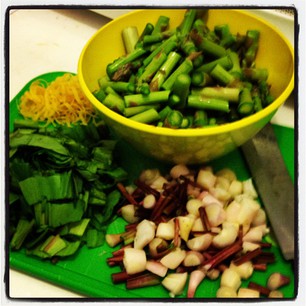
I got the most gorgeous ramps (wild leeks) at the farmer’s market last week. After a bit of googling, I decided to roast the stalks, then chop the leaves finely and saute them with mushrooms. Ramps have a very distinct garlic/onion flavor to them and roasting brings out their natural sweetness. Yum!

I had planned to buy some Arctic Char, but when I got to my favorite fish place they had John Dory. The John Dory was probably a bit mild for the ramps, but it’s my favorite fish so whatev. 

Preparing the ramps was more of a technique than a recipe so I won’t bore you by sharing it. If you’ve roasted and sautéed veggies before you already now what to do. In addition to roasting, you can pretty much use ramps in any recipe that you use leeks in, just be prepared for the (awesome) garlicky flavor! 

Delicious! Definitely not missing the meat.

Dudes, Meat Break 2012 is gonna be mad sick!

One Sick Foodie

My plan for Sunday was to make some fish and roast the gorgeous ramps I got at the farmers market a couple of days ago. However, after throwing up all of Saturday night and Sunday morning, this ended up being my Sunday meal:

Those are Saltines back there and ginger tea in the mug.

I didn’t go to work today, but I am feeling better so hopefully by tomorrow I’ll be back in the swing of things and have yummy recipes and food realted topics for you.